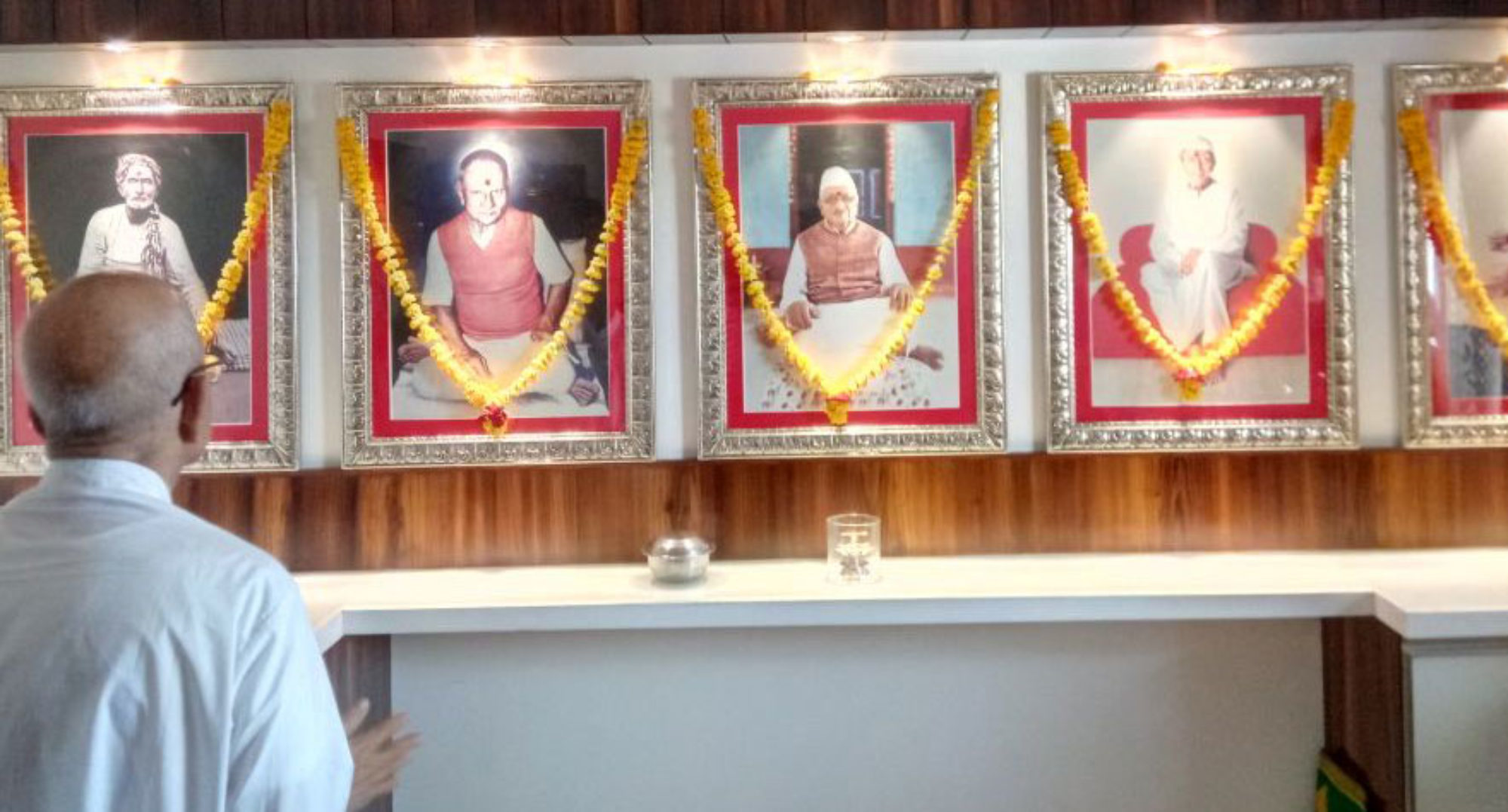
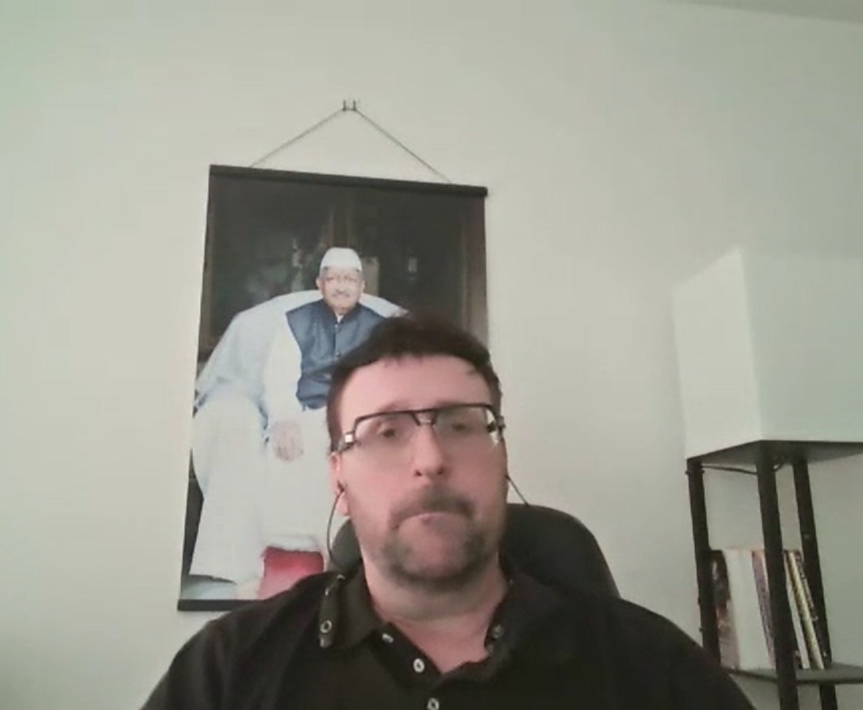
This is the Tuesday Talk held June 16, 2026. Tuesday Talks is a gathering on Zoom of devotees from the Ramakant Maharaj USA visit. This is a gathering of devotee’s to discuss and clarify the teachings of Sri Ramakant Maharaj. These spontaneous utterances are recorded and shared with anyone who may find them useful.
Jai Sadguru!
Tuesday Talk June 16, 2026
Transcribed by TurboScribe.ai. With limited Edits
Q: We haven't had many questions lately from the viewing people.
John: That’s true. One was on YouTube about, are there any masters in the lineage giving Mantra in India? I didn't answer, but somebody said something about some Maharaj.
I don't know that answer or how he's affiliated.
Q: But is it our lineage?
John: I honestly don't know. When the person answered, they put another person's name in the response. I don't really monitor or do anything unless somebody gets crazy and says crazy stuff. Then I'll delete their comment. Yeah, just because I used to leave it there. Then people said, oh, you shouldn't leave it there. It's not right. I was like, well, you know, it is what it is. If it's kind of off the wall, then I'll delete it.
But that wasn't off the wall. I just didn't have any idea who the Maharaj was that he was talking about. But yeah, as far as people emailing in, nobody's emailed in any questions. And it's good, actually, because all questions are body-based. If you know yourself in a real sense, there won't be any questions.
The question and the questioner are one and the same. Oh, if I'm formless, let me form a question. Now I'm going to put myself in the form of a questioner that needs a response to a question about the formlessness that I am, that if I didn't ask the question or I didn't try and figure something out, I would just remain as myself.
I'm not beating on questions. I mean, questions, even Maharaj says, ask questions until you're completely fulfilled. Don't just sit there and say, oh, yes, yes, yes, understood. Oh, yes, yes, yes, yes, yes. If there are questions, definitely you want to get rid of those questions. Again, just like in Dasbodh.
Dasbodh begins with, this is the question, the doubt. Then he irons out four or five steps of the doubt. Then he goes around and clears the doubt. And at the end, he states, this doubt has been cleared. Please pay extra attention to the next chapter. And then another doubt comes.
Because to have doubts, you have to have a doubter. The form of the doubter is not true. So, there can be a billion doubts, as long as you believe yourself to be a doubter.
Oh, I doubt this. The I that doubts is not true. So, you remain with your Selfless Self, the doubt passes.
Q: Occasionally, I feel like that where I have no questions.
John: So, well, and as Maharaj says, Aatmanivedan Bhakti, I think he says, which is when Selfless Self is responding to yourself, it responds spontaneously to your own self. And many times, you do that in the so-called illusory existence. You'll have the knowledge to manifest itself slowly for a time until the understanding comes that the question and the questioner are one and the same.
The doubter and the doubt are one and the same. So, just as concentrating on the concentrator removes the concentrator through the concentration, the doubter and the doubt remove the doubt, you remove the doubter. There are no more doubts.
If you give it to mind, of course, then it'll be an infinite supply of new things that need to be figured out. And until you know yourself in a real sense, anybody could come to you and say, you know, you should really go to this church, or you should really do this, or you should really do that, or, you know, you need to do more sadhana. These people that say you're already that, it's not true, you know, the Bhagavad Gita says, “blah, blah, blah.”
And once you know yourself in a real sense, as Maharaj says, okay, I've seen the whole elephant. So, when somebody tells me that the elephant is like a trunk, or is like a log, or is like a big billowy, like a leaf, okay, it's true. This is part.
But if you see the whole elephant, you won't say elephant is like a log. No, you won't do this. When you know yourself in a real sense, you won't say, oh, yeah, you're right, you know, or you sit there and you're like, well, what if this other person is true?
Or what if this religion is really what I should have done? Or worse, like Maharaj talks about guru hopping. What if this guru has something that this other guru didn't have? I began with Maharaj, but now I'm going to go to this Ashram over here and spend some time, because they're going to give me like that extra. And within the illusion, of course, the mind is used to acquiring. It's always better to have more.
You go to college, you get a Bachelor's degree, lovely, but now you want a Master's degree. Get a better job with a Master's degree, now you want a Doctoral degree. And the same thing, the mind is conditioned to go guru shopping.
Oh, I learned so much from this master. That's why a lot of times, and even in Ramakant Maharaj USA, when we were here, one person had said, what Mantra to use, because they have been given several different Mantras. And Maharaj was like, if you've been given the Naam Mantra, use Naam Mantra.
So, what about this other one? Well, again, I have complete trust and faith. Go ahead.
Q: I was wondering about, you know, before you went to see Ramakant, you were doing Mantra, and then when you got the Naam Mantra, there was like a change or a deeper connection or something?
John: I discarded, because when I didn't have Naam Mantra, I looked up in the Upanishads, and it was like, yo, so, yo, so, hum, saha, so, hum, asmi. Yo, so, hum, saha, so, hum, asmi. And I walked around all of DC doing this.
This is fine. I didn't have Naam Mantra. There was trust and faith that it was like, it appeared in my experience, so to speak, and I was true to it.
And that was also during the time where I was listening to, I didn't listen to any of my rap music that I listen to nowadays. I was just listening to, like, Mantras and Om Namah Shivaya and all that, but to music. Actually, it used to drive my son crazy, because I would go pick him up, and we'd drive all the way to King's Dominion, and it would be nothing but chanting, Om Namah Shivaya, Om Namah Shivaya, and, you know, all this stuff, and it was like all these different Mantras put to music, and that was okay for the time.
I was still believing myself to be on a spiritual journey, and there were still doubts, but that was leading to Maharaj. Once meeting Maharaj, surrendered all Mantra, surrendered everything to the feet of the Master. Mantra, put your hand on the head, whisper in the ear, from now on, use this Mantra, Yes, Master.
And that was it. And I didn't ask when it would work, or if it would work. That was the really cool thing.
Like, once given Mantra, I just started beginning using Mantra, and then got the quote experience of the Mantra by noticing that, oh, here I am. I'm walking to this place in India to have my beard shaved off, to have my hair trimmed, because when I went to India, my hair was very long. I had the Rudraksha beads.
I had a big bushy beard and everything. All that was just gone, and I didn't sit there and say, oh, I should shave. It was, I'm concentrating on Mantra. Here I am sitting in this chair, getting my hair and my beard shaved off. Not hair shaved off, but haircut, beard shaved off. Then walking around.
Mantra, all of a sudden, just walking around. Had to take a rickshaw back to the Ashram, because I had wandered long time, long way away. And that's the power of the Mantra. That's why Mantra, and it's not sitting, as Maharaj said, it's not just sitting for Mantra. It's continuous in every moment. Taking a shower, Mantra. Washing the hair, Mantra. Putting on the clothes, Mantra. Walking to the car, Mantra. In the traffic, Mantra. At your job, Mantra. And it's just, you then start to begin to see that there's no thought process involved.
You do your job, do your duties. It flows. It flows very nicely, because mind is concentrated on Mantra. It can't get up to mischief of even to think, is this Mantra working? Because eventually you begin to see yourself just flowing. You're concentrated on Mantra, and body seems to be moving about and doing all these various things, but you're concentrated on Mantra. Jai Guru.
Q: Jai Guru. Unfortunately, I can't remember to do it as much as, as much, I forget to do it a lot. I have a really bad memory now. It's part of me. Also, I just, I guess I let myself get distracted, but.
John: Well, but even being distracted, you notice you're distracted. There has to be a noticer of distraction, correct? So as soon as you notice yourself get distracted, Mantra.
Q: Oh, I do that, but then I forget for long, you know, too long of periods. I put post its around that helps, helps remind me, you know, just seeing the post it there.
John: Well, at nighttime too, do you want to sleep a nice, peaceful sleep? Mantra for your sleeping, or Mantra yourself to sleep. And again, after a while, then you understand. Mantra is naturally running through the body. Then body becomes just kind of a flute and instrument because you're no longer doing Mantra. Mantra is like 1400 times per day. Mantra is coming and going and it's just natural. But anytime you sit there and you say, wow, I'm having a really great experience. Aha. This would be a good time to just pause. Mantra. Thank you, Master. Not going to fall back into the illusory ditch. Just like you said, Bhajan's Mantra, no illusory ditch for me.
Q: It does seem like, when we, Dasbodh talks about discrimination, and it does seem like Mantra kind of facilitates that discrimination kind of like naturally or something.
John: Yeah, because when you know yourself in a real sense, everything other than yourself is not you. You can easily discriminate between illusion and reality. If you can know it and name it, it's illusion. Because even the sense of Presence, remember, that is illusion. The discrimination is, oh, this sense of Presence, whether it is or is not, the knower of the sense of Presence is. And I am the knower of the sense of Presence. I am that.
Q: That's what Ramakant's referring to. He says prior, prior to.
John: Prior to beingness. How were you prior to beingness? Well, I don't know.
You're not in any form. Beingness has appeared, beingness will disappear, but the you that you are will not. You are constant.
Q: It just has to reveal itself gradually, you know, more and more, but very slow. He says slow, but to me it's really slow.
John: It's okay, slowly, silently, permanently. You remain with your Selfless Self. And that's why just my son and I went to go see Disclosure Day on Saturday, and they were talking about like, oh, if these aliens are supreme beings, then how can God exist and all that. And I even told my son, you know, we talked about this in Tuesday Talk, that it's Presence. Quite frankly, within the Presence, aliens can quite nicely appear. They're forms. So there is no discrepancy. Oh, how did these aliens come from billions of miles away? Because it's Presence.
It's the bubble of illusion. The consciousness can create this in your dream. You can have a dream tonight that aliens come and visit you, and you're starting to have friends with aliens. Everything was within the dream, and everything was your own self. When you wake up, you know this. When you know yourself in a real sense, nothing is outside of you. It cannot be. You're formless. Therefore, any form is like the space in the room and all the objects in the room.
Q: That gradually becomes apparent. I forget.
John: Or you remain with your Selfless Self, more with Mantra, more that sense of Presence. Because as you're meditating, suddenly this mind flow, and that's another thing, if for beginning meditators, okay, you're sitting and you say, oh, I cannot sit for meditation. I have a busy mind. Mind is just crazy. Great. Now you can sit as the observer of the mind flow.
Once you're the observer of the mind flow, obviously you're outside of it, because it's something that can be known. You're the observer of the mind flow. So, mind thoughts come and go. You remain. As you're remaining with that center of awareness of the thought, thought is no longer in your awareness, because your awareness is aware of awareness. That's the sense of Presence that will suddenly be felt, because mind is no longer that covering, that illusory layer. It disappears. So now you sense the sense of Presence. Even for the first time, it's like, oh, what's that?
Meditate. Now, the more the concentration on the concentrator, meditate on the meditator, that dissolves. You remain. The sense of Presence is sort of just I, just I. You still remain, but you can't say what remains. So, then you start to transfer the identification away from the body, away from the thoughts, to this subtle sense of Presence.
And this is what Siddharameshwar Maharaj did in Master of Self-Realization. He says, like, the great causal body, the causal body, all the way down through all the bodies, the physical body and all these bodies, be removing, removing, removing, until that which cannot be removed is there, and that is your own self. So, removing this sense of body, you say, okay, I am more like this subtle sense of Presence than I am this body or this mind.
Now go about your daily duties knowing this knowingness appears, this subtle sense of Presence. I'm more like the space or the sky than I am this body form. And after some time, it will dawn. Oh, whether this sense of Presence is or is not, I am. Now, where's the doubt about birth? Where's the doubt about death? Where's the doubt about having a bad day? Where's the doubt about sadhana? Where's the doubt about practice? Cannot, there's nowhere to hang the hat.
Q: Besides the Mantra, it does seem like certain concepts do help connect me with the subtle sense of Presence. Like today, I was contemplating non-attachment, and just that, just that word seemed to help clear, you know, give me a discriminating, like an awareness to distinguish what is attachment. I could distinguish what was attachment and what wasn't.
So, just for me, sometimes concepts actually, well, it's a concept that is not, it's not the same as other concepts or some non-attachment, because you can actually feel the non-attachment or something.
John: I mean, again, while you're in the business of concentration, Presence may be available and felt like that. However, just like Maharaj talked about in, when somebody asked him about Vipassana meditation, Vipassana meditation is controlling the breath. Sense of Presence can be felt.
It's very nice. But as Maharaj said, this is egoistic meditation, because as soon as you stop the Vipassana meditation, now suddenly everything is back to where it was. Whereas when you know yourself in a real sense, that's it.
Q: Can you hear me?
John: Yes, yes, Jai Guru.
Q: I do think Vipassana helps people become more aware of what they're doing in the present moment. Because if you do it a lot, then when you're waking up, instead of just, oh, I'm waking up, you even become aware of your eyelids opening up. And so, your movement in being the watcher, as we are, becomes more intensified, I think. For me, it did. I don't know.
John: Yeah, I mean, it's, again, that's a progressive step. And especially if there was no Mantra, if you were not, you were doing it. Oh, there was no Mantra?
Yes. You have taken the Mantra?
Q: I have taken the Mantra for our practice, yeah. But not for Vipassana, yeah.
John: Right, right. No, but what I'm saying is, if you've taken the lineage Mantra, it's like the God of your understanding, so to speak, whispered in your ear and said, this is the key out of illusion. Use this, and you'll escape illusion.
Whereas this kind of, again, this egoistic meditation is, I am doing the Vipassana meditation, or I am doing a specific meditation, rather than the Mantra. It's just, literally, it's concentrating, because the Mantra is naturally running. Breathe in, breathe out.
Breathe in, breathe out. And any thoughts about doing Mantra will be swept, because slowly, silently, permanently, these thoughts are being swept out the door. And then there's that pure realization, that subtle reflection in an empty mind, so to speak, where it's awareness of awareness, concentration, concentrator, meditation, meditator.
Oh, so that I, I am that. And it literally removes the support, whereas an egoistic meditation is sort of clearing, but keeping the support. Because you're actively, I am doing vipassana meditation. I am doing this meditation. Mantra is not; it's a broom. The antivirus software, basically all the wrong files are, from this body perspective, I believe myself to be a body.
I was experiencing, I was going through life, I was doing these various things, I'm feeling these various feelings, but all of that is from the wrong perception of being a body. So, Maharaj gives Mantra to erase all this illusory layer, all this, my experience, my things that I do, my actions, my past, my future, my job, my family, all body relations, everything that came along with the body is erased, and yet you are. So not, and just as Maharaj said, it's not beating on it.
People who like to do vipassana and don't have our Mantra, it's okay. It's just a progressive step.
Q: Yeah, that's, that's, I believe that.
John: And I actually put on the website, the, if you don't have Mantra, there's a short little video, about 12 minutes, that says what to do if you don't have Mantra, and it goes into the various things, and how even in the books it talks about specific Mantras, and how they would be able to help on this.
Q: We're about people on other paths. I'm sure this isn't the only path that has enabled people to be free of their egos or whatever. And like, towards the end of last week, or last time we got together, I said something about Nisargadatta.
When he had the pain, oh, he just turned, he was turning everything over to the I am.
John: Still in pain, but understanding that this pain is through the I am. The you that you are is not in pain. The you that you are is formless. It's the I exist, the sensation that is registering I'm in pain, because there's an I. But the truth, the reality, is there is no pain.
Q: But the pain is still felt by the body though, right?
John: Well, there's still pain, yes, yes. The body is a lump of goo, and has all these sensations, or sensory, you know, if you put your hand on a hot stove, it's going to burn. It's going to be hot.
There's going to be sensations that go through the body, and because you're the holder of the body, you're going to register this as I am in pain. What Nisargadatta Maharaj was saying is that the understanding is there is no I in pain. The true you, just like birth and death.
You know, somebody sits there and watches a baby be born, and says there is no birth, and thinks you're crazy. Or you go to a funeral, and you say, oh, there is no death, and they think you're crazy. Because from a body-based perspective, both of these conceptual elements attach.
There's a body, there's birth, there's death. But the you that you are is not born, does not die, never was a body, never had any experience. Again, just like in dream.
The dreamer is not experiencing what's in the dream, even though you're experiencing what's in your dream. You go to bed tonight, and you're dreaming that you're running, and within the dream, you're having the experience of running. You wake up, and you know, I'm not running.
And it's the same with the pain. And yet, physical sensation, you're the holder of the body, you're feeling what this body is feeling. But the you that you are is not within the bubble of illusion, the concept of pain, concept of pleasure, the concept of birth, the concept of death, concept of family.
Q: So where is the I Am in that?
John: Well, again, the I Am is the sense of Presence. When we talk about, I Am, or Selfless Self, any of these things, it's the Self without self, the just I, just I. The I Am is that subtle, subtle just I, just I, which we label as Presence. And yet, the knower of just I, the knower of Presence, the knower of the I Am, is not affected by anything that's going on in that bubble of illusion. You're not in the illusion.
Q: So, the sense of Presence could be comparable. It's kind of like the pain, also. It's like you have a sense of Presence; you have pain.
John: No. Pain comes along with the body. Presence, the knower, that's the first known. I exist. I Am. Just I. I without anything. I prior to body. I prior to mind, ego, intellect. All of that appeared on your spontaneous Presence, but you are not involved in that. Pain came along with the body. Prior to body, you have no pain. How? Body form is available, which is the key to the illusion, is I exist. Of course, there's existence, but the I exist kind of impression is the key to illusion.
Boom. Whole dream world appears. You lay down at night, sleeping. You're in deep sleep. Nothing. You're there, of course, because then as the stirring of existence happens, consciousness creates a dream world, populates it spontaneously.
You're a character in the dream world. You begin a little story within the dream world. You have characters within the dream world, and when you wake up, you know it's all your own self.
Couldn't have been anything other. In deep sleep, you're there, but there's no knowledge that you're there.
Q: Knowing you are there, that's not quite the same as the sense of Presence either, though.
John: Yeah, the knowledge of existence is Presence. I exist. Just I. I Am. That's why Nisargadatta Maharaj says the I Am is the door. On one side of the door is illusion. On the other side of door is your own self. The formlessness sort of walks through the door by I exist, and I exist is now in the illusion. The sense of duality is impressed spontaneously. I exist. How did this sense of existence arise? Because this body was available.
The space in the room attached to a five-elemental lump of goo and suddenly said, I exist, not knowing that I was the space because I wasn't knowing myself as the space. Then knowledge came about when the body form appeared and said, oh, I exist. I see. I do. I am.
Q: In a sense, though, the form is also the space. It's kind of just a space also.
John: It's an object in space. It's an object in space from the five elements created through the illusion. The illusory existence is created from the five elements. They talk about that in Dasbodh, like it comes from, you know, water and fire and earth and air and all these sorts of things, and sky and all, or ether, I guess it's called. But the five elements are in the bubble of illusion. There are no five elements for you until you enter the bubble of illusion.
Q: Because to me it's, I don't know, maybe this is conceptual, but I think of the elements as being sort of formless also, because there's nothing, because they change, they're kind of formless.
John: Well, they're not formless or with form. Just like, again, in your dream. You dream tonight that there's a tree. You can tap on that tree, but it's not true.
Q: It's just a sensation, a temporary…
John: Is it form? But is it formless or is it form? Within the bubble of illusion, you're interacting with it as form, because you yourself have identified as a form. You cannot knock on a tree if you're the space. But if you believe yourself to be an object, then you can knock on another object and say, this is an object. When you wake up, none of it was true.
When you know yourself in a real sense, there's no form, there's no formlessness. There's no consciousness or unconsciousness. Nothing is there.
Nothing. Except your Selfless Self, there's no God, no Brahman, no Paramatman, no Master. Nothing is there. Something appeared from nothing and goes back to nothing. Only the something for a time is all illusion. There never was a something. Even your sense of existence does not age. The body is aging. You look at yourself in the mirror, you say, oh, I was young man, medium man, old man, really old man, or woman, or whatever. But not true, because you're not aging. The body is aging. And the body is aging because it's a five-elemental body.
Q: Occasionally, I feel like I'm the same being that I was when I was a kid.
John: You are. You never have changed. You're formless. There's no birth or death, there's no aging, there's no nothing. Bhagavad Gita talks about you can't be cut, you can't be lit on fire, none of these things, because you're formless. The you that you are is the exact same as it was the moment the sense of existence said, I exist. And after the body form is no longer available, you exist. Without the sense of existence, you exist. Because the sense of existence has appeared to you. If you did not exist, prior to the knowledge of I exist, how could the knowledge I exist appear?
Q: Yeah. That's sort of what I mean by unattachment to them.
John: Again, why use a body-based concept? Understand that even all the body knowledge is completely useless. It brought you to the point where Maharaj whispered in your ear and said, “This is the end for you.”
Transcribed by TurboScribe.