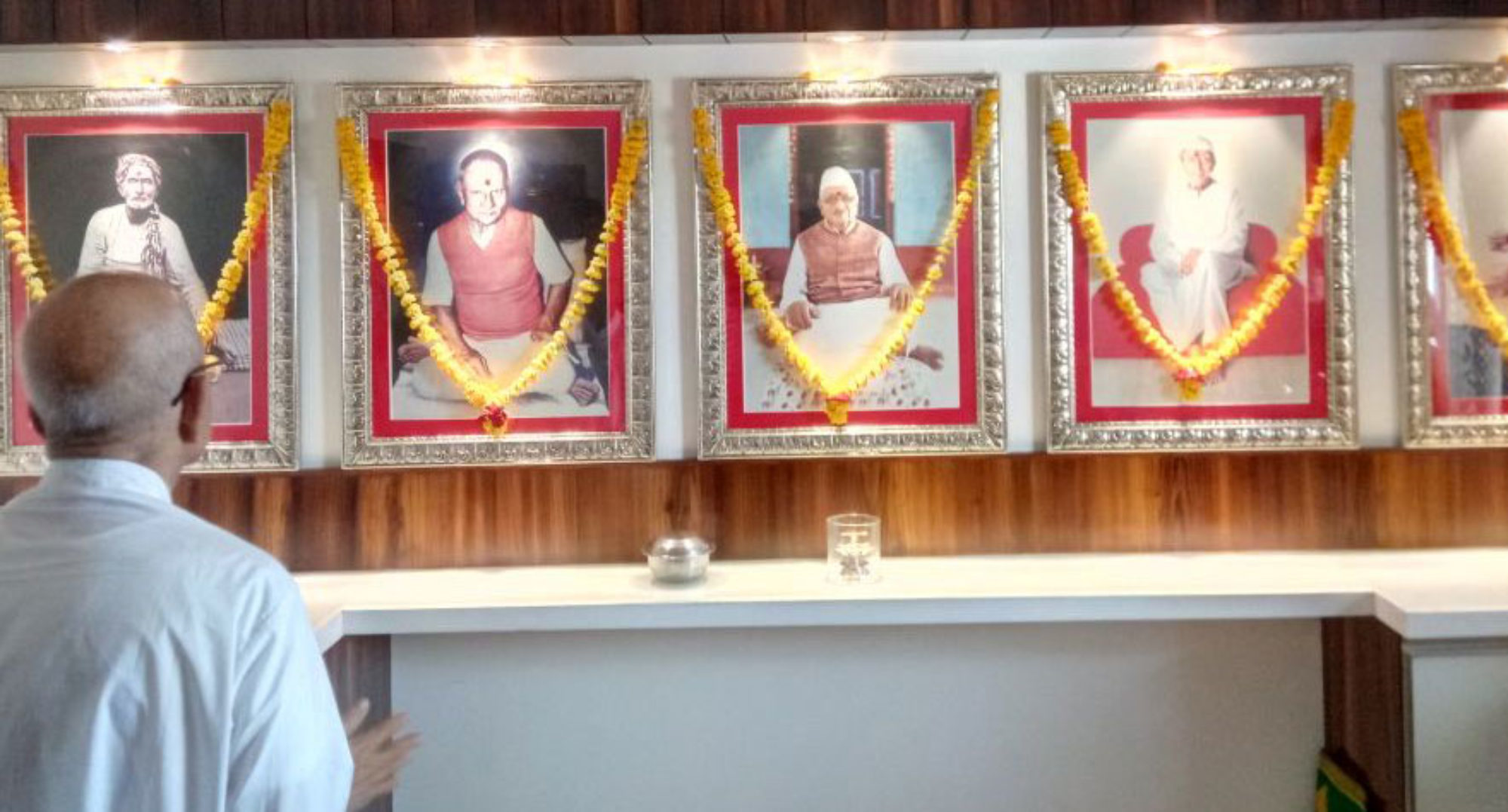
This is the Tuesday Talk September 15, 2026. Tuesday Talks is a gathering on Zoom of devotees from the Ramakant Maharaj USA visit. This is a gathering of devotee’s to discuss and clarify the teachings of Sri Ramakant Maharaj. These spontaneous utterances are recorded and shared with anyone who may find them useful.
Jai Sadguru!
Tuesday Talk September 15, 2026
Transcribed by TurboScribe. With minimal edits.
John: There we go. Okay. Am I too loud or not loud enough?
Okay.
Q: Sounds fine.
John: Okay. Yeah, I'm trying to find that.
Okay, I think that's fine.
Q: Is it just me and you so far?
John: So far it's just us. That is correct.
Q: Okay. What happened? Oh, something is, I just turned my computer not long ago and something is, one of the things that comes up at the beginning of startup thing is interfering with my visuals here.
Oh, there we go. I had to block them out.
John: Yeah, I had to, just before this, do a restart to do some kind of update. I wasn't sure if the update was going to finish in time to be here.
Q: So, the master of questions is here, but I'm starting to come up with my own answers.
John: This is good. This is good. Maharaj calls that the Atma-Nividam-Bhakti, where it's starting to, your answers will appear spontaneously as you're asking the question, because the questioner and answerer are, of course, the same, but it'll start to appear this way.
Question comes, but mostly it's because any question is a body-based question. You can't ask a question without forming the position of a body. So, any question you know, oh, I am not body, therefore the question dissolves.
Q: And what's left is you, the questioner, or where it formed at.
John: The formless questioner, yes. The formless questioner that asks the question through this form, because without this form, no question could be asked.
Q: Yeah, yeah, right.
John: Like the space in the room is not going to ask you about what's inside of it. But if the space in the room was to suddenly realize I exist and have this instrument available, it could say, huh, where am I? Who am I?
Q: And that's what we, you're talking about our normal state of mind where we're, we think we are our own being or something?
John: Well, just the concept of existence. You know you exist because of a body form. Otherwise, you're formless. And that's why you, the you that you are, has nothing to do with the material world. You can't, because you're formless.
Q: Yeah, one of my things I've been recently keep coming back to is that there's freedom, which the formlessness is freedom itself, kind of. And what I'm seeking and what I think seekers seek is freedom from what we seem to be. And, but before we become, we might also be seeking freedom for what we seem to be.
But actually, with when humility comes into play, you're actually, I'm actually looking for freedom from like a mentally formed sense or a sense of ownership and stuff.
John: Just the concept. That's the only thing you need to be free of. The concept of I'm this body. I exist as something rather than existence itself, the Ultimate Truth. So, there's really, for the you that you are, the you that you are in reality, has no desire for freedom, has no desire for anything. It is freedom though. And without the concept of freedom.
Q: Right, right.
John: The concept of freedom came through the duality, the dualistic existence of I exist. I exist as something. Now, I wish to be free of this something that I believe I exist as. But the truth is, you are not that something. So, the freedom is just a body-based concept. Because in order to have freedom, you have to have bondage, but the bondage is illusory.
It's as if you were arrested and the police, they say, okay, put your hands together, put your feet together and shuffle and don't move. No handcuffs, no nothing. But you, they're telling you, oh, you're cuffed. We're taking you in. And because this is impressed, you say, oh, I can't move my hands or legs. Or they give the example of the elephant. The elephant's huge, and yet they can push a little, just a very small peg into the ground. And the elephant believes it's staked, it can't move. And yet the elephant could easily walk away and pull this out.
But there's the belief, this limiting belief that I am in bondage. And then that's why you say even the people who they say, oh, I'm free, but then you're in bondage within the mind, in the flow of illusory thoughts. Even your body can be in a cell, and yet you're feeling the mind is of freedom. You're not allowing this physical circumstance to limit the concept of freedom. And so that shows you right away that freedom, it comes and goes, absolutely illusory. It's just a fantasy thing.
Q: It's a word with a meaning.
John: That we attach. And only when you're in the body-based existence. Even in a dream, freedom would mean nothing.
Q: Right, right. You don't think about freedom when you're in a dream.
John: Yeah, well, even if you did.
Q: Yeah, you might, you might.
John: When you wake up, you say, well, wait a minute, what is this concept of freedom? If I'm thinking this way, the freedom must have been the dreamer dreaming outside of the dream. Therefore, he was totally and completely free, since he had nothing to do with the dream. And yet the concept of I am free in my dreams doesn't arise, because that wouldn't make any sense at all. And so, it's the same. You know yourself in a real sense, the concept of freedom doesn't make sense, because there is no bondage.
There's no limitation. In a dream, when you wake up, there's no limitation anymore, because you're no longer dreaming that you're in a dream.
Q: You know, all possible limitations are within limitlessness.
John: Yeah, how can the sky be limited? Maharaja always uses the example of sky, and then, of course, points to, if at all you want to compare, compare yourself to sky or space. But of course, you're more subtle than sky or space, because sky and space can be sensed, or seen, or felt, quote, experienced.
You can experience sky because you look up and you see, oh, there's sky. But the only real way that you can look at the sky are by the objects, the clouds, in it. Otherwise, how would you say, like, oh, the sky is doing what? The sky's not doing anything. The clouds are moving through the sky.
Q: There's something within, well, I don't know if it's within or outside of the people that are like you or Ramakant, that are willing to share or exposing the limitations for what they are, that makes you willing to share this.
John: It's just spontaneous speaking from direct experience from that. There's no...
Q: You could say it's like a heart thing, that there's a heart of us that likes, you know, that shares the ability to see limitations. It's like, you know, Ramana Maharshi used to talk about the heart more than like this.
John: But he would talk about the heart and blast people's concepts about the heart. Because the heart is not this physical organ, nor is it located anywhere in the body. He said it would be in the center.
The center of what? Not the center of the body, because he knew that there was no concept of body when he's speaking. So, when he says the center, of course, if you're identified as a body-based concept yourself, you'd say, oh, the center here, or maybe here, the third eye, so to speak.
But Ramayana Maharshi said the center of you, not the center of this illusory thing that you keep claiming to be, that he's trying to shake you out of. Hey, you are not this body. And Ramana Maharshi, I read the books all the time from him as well in the morning, during my morning readings, and just very similar to the way the Bible got totally kind of misconstrued, the similar things, you know, the book says, it makes grave detail in telling you that Dr. So-and-so from such-and-such a district traveled so-and-so far to see the Maharshi. Like it was, they made him into an idol, and that's not his thing. When you know yourself in a real sense, when people come and bow at your feet, it doesn't, you should not, basically. Of course, in the beginning, bow to the masters, this is good. But to make it an idol is terrible. Same thing they did with Jesus, same thing they did with Buddha, and they're speaking from the bottom of reality. Same thing with Sri Nisargadatta Maharaj. So many people are like, oh, Sri Nisargadatta and Sri Ramakant Maharaj, but it's not the body. They're not the body. Sri Ramakant Maharaj, Sri Nisargadatta Maharaj, Sri Ramakant Maharaj, Sri Siddharameshwar Maharaj, you and me, so to speak, are that.
Q: Right. No, that's why Ramakant would say, bless yourself, touch yourself on the head or whatever.
John: Exactly. Put your hand on your own head and bless yourself, because you are that. And that's why the commercialization of spirituality is so damaging to the poor spiritual seekers who are seeking and paying money, because they're idolizing something.
A Mooji, oh, we're going on a spiritual retreat, we're going to go see Mooji. Or, oh, we're going to go on a spiritual retreat and go see Amanda Maya, or whoever the lady is who gives out flowers and stuff. People love that, because that's body based.
It's like a little puppy, and she's sitting there stroking the little puppy, and the little puppy is very happy because it's being stroked, and oh, this is so peaceful and so beautiful, I'm being stroked. But the hammering is, that's why there's no spiritual journey. How can you have a spiritual journey if you don't have a body?
And if you think you're a body, all you're doing is dragging yourself around to all these various places. In the beginning, of course, it's good. But when you know yourself in a real sense, as Maharaj says, wherever you are, that's your Ashram.
You don't need to go to separate Ashrams, you don't need to bow to people, you don't need to do any of these sort of things, because when you know yourself in a real sense, you're completely outside the material world. And yet the body form's available, but you're completely outside the material world.
Q: Yeah, I'm starting to, you know, as some, I guess as the layers are being removed, I start to get a stronger sense of, like, I don't know how to explain it. I mean, it has something to do with the bliss that's involved, but it's like a type of, like today, I felt like a type of solidity, kind of like that wasn't related to the body or any of my past experience, you know. And, but it's almost like, I mean, it's not totally solid because there's movement.
So, I guess you would say in the Dasbodh sense, maybe there's wind going on within this, what seemed, what sort of feels like a solidity or something.
John: But you're experiencing the wind, so you know that the wind is moving, you are not. The bliss is just a layer on your Presence. Oh, bliss.
It's very nice, but even that, that's why Maharaj says when no bliss is needed, no peace is needed, there you are, because these are just layers, illusory layers on your spontaneous Presence, even thought, thought flow, anything, it's a layer. When using the example of the ocean, waves are here, you can have a tidal wave, you can have tsunami, and deep, deep, deep, deep, deep, deep in the ocean, no movement, no light even. You know, they say the deep, deep, deep ocean creatures, they have like glowing eyes and stuff, because there's no light.
Not even the light of the sun can penetrate it, because that's the deep. When you know yourself in a real sense, everything is surface away, because again, we talk about going back into, okay, I believe I'm a body, I'm gonna sit, I'm gonna meditate. As I sit and I meditate, I notice that I can observe thoughts.
The more I observe thoughts, the more I understand that I'm not involved in the thoughts, the whole thinking process is something outside of me. So now I'm not as contained within this body, because these thoughts are keeping me pressurized, believing I'm something else. Then this subtle, subtle sense of Presence starts to be felt, because I'm no longer paying attention to the illusion, I'm beginning to pay attention a little bit more to the reality.
As Sri Nisargadatta Maharaj says, the I am is the door. On one side is the truth, on the other side is the illusion. So, this sense of Presence, this I am, this I exist, and now anything that I have left, I can transfer and say, I'm more like the sense of Presence, sky or space, than I am this body.
Thought comes about the body, it's discarded, because I start identifying, I'm formless Presence. Now the more I identify with the formless Presence, that's the deep ocean. No light, no concepts, no nothing.
Any concept is pulled in and dissolved immediately, because I am the knower of the sense of Presence. This sense of existence, this sense of Presence, this I am, can be known. If it can be known whether it is or is not, the knower is.
That's the deep ocean.
Q: It's the only thing that cannot not be.
John: Correct, correct. The Ultimate Truth. Where all illusion is discarded, Ultimate Truth.
Because you say, like, the truth, right? Okay, what's the truth? The truth is you are that.
Ultimate Truth is, you are now with your own Selfless Self. Self without any concept of self, because that concept of self has been dissolved and cannot remain where you are. Now, don't make a big deal about this. Go about, do your job, do your duties, take care of your responsibilities. You know, no need to set up shop or have people write songs about you, or write many books and tell people how they can do this thing. Just be normal, be simple, be humble, be always with you.
Q: But I do have, I have like a couple of friends that, especially right now, when I recently talked to him about this, and he, we've talked in the past, and he's very interested in it. He's, he does, you know, he gets it to some degree, but also he's not experiencing the bliss maybe as much as I am or whatever. And so it's like I'm, I'm kind of, when I talk to him about it, I'm explaining to him that, say that, for example, that it's the sense of objects and objectivity that is making us, distracting us from the bliss that's here and stuff like that.
He sort of catches on and he starts feeling bliss, you know, as I'm talking about this stuff. So, you know, I feel, you know, it's worthwhile to share this with him and then maybe he'll be inspired to do it, you know, to get deeply involved.
John: And as Maharaj has said, as long as you, if you know yourself in a real sense, and that conviction is there 100%, spread your carpet and start speaking. It's only, but you have to know, because if Keith is sharing ideas and concepts, it's not the same as speaking from reality.
Q: Yeah, you can sort of tell, you have this, you can tell when you're being…
John: You can feel it, you can feel it. When you see, even you go on YouTube and you see different various spiritual folks, like the Facebook folks and stuff, when they're speaking, you can tell it's from a position. And also, you can tell because they like look and make sure they're everything's good, my hair is nice, everything. Okay, let's set up the lighting and all that. Let's do that, you know what I mean? So, it's like, it becomes a show.
Spontaneous speaking in the moment, there's no, it's just a flow. It's just, even in my everyday life, you could say, when I was going to, you know, the meetings and all that, and people would come and we would talk about different spiritual concepts, and it would just flow. But seemingly, there wasn't like a blockage of, oh, you're speaking Advaita, or oh, you're speaking about this. It was just a flow. What they're speaking is speaking back. And it's just because the speaker and listener truly are one in the same.
The bodies are the only kind of separation, so to speak, as Maharaj uses the example, the bathroom and the Ashram, the space. It's separated, seemingly, by walls, and yet space is not separate. You can't separate space. You put space in a box, and you say, oh, I have some space here. But it is not.
Q: Everything is within the space.
John: Exactly. The box is within the space that the box of space is within. So, you can't say this.
And I, in the very beginning, long, long, long years ago, I used to, as I just started feeling this sense of Presence, I noticed that if you look eye to eye with someone, seemingly, you can feel the pull of Presence very, very strongly. And during that time, before knowing any better, really, I understood this as like this pull of God, basically, that you could, you could feel the Spirit of God inside of someone else, and they could feel yours. And I used to actually kind of play with this a little bit and be like, not in a disrespectful way, but in a way of sitting there and being like, you know, a calming-ness.
And you can even see in the eyes, like the eyes start to kind of, you know, the body is responding to the peace that's being transmitted, so to speak. Again, this is all within the bubble of illusion.
Q: Well, that's how we all get along. I mean, because we see each other in our…
John: It's an acknowledgment at the very beginning level of the Spirit in you is the same as the Spirit in me. There's a knowingness of this, because the you that you are knows. Absolutely, 100 percent, because when you come to the understanding that I'm not a body, then all of this whole, quote, existence is within you.
And there's no…
Q: No, it's the whole, every variety, the whole spectrum of the gunas, everything.
John: Everything. All of that is all within your own self. And we say within only to try and give a concept, because, like, at first you believe thoughts are coming from your head.
When you're no longer identified as a body, and you know yourself in a real sense, more like the formlessness, thought becomes the world. All the objects, everything moving about is the same as your dream. There is no difference at all.
Only when you wake up from a dream do you know that all this whole world was just not actually true, and only when you know yourself in a real sense, all this whole world was not actually true. And then birth and death, and all these concepts, they just can't stick. They just can't. There's no place to hang that hat of, what about birth? What about death? What about the afterlife? Explain heaven. And then you see clearly, like we were talking, you know, the whole idea of the Bible and how everybody wrote down what Jesus was saying. He's speaking from the bottomless bottom of reality, but they're interpreting it through body form.
If I'm a body and somebody says, God and the Father and I are one, then it's like, oh, so you're saying, what, you're God, or you're this or this? And those people stoned him for that, and then years later, then it became a whole religion. But that's not what was said.
And literally all religions, as Maharaj says, you can look at the foundation of all religions, the people wrote down what the bottomless bottom of reality said, but from the perception of being a body in a world. So therefore, everything was topsy-turvy, as Maharaj says, the antivirus, because the virus begins with, I am a body, I am somebody else. I'm hearing some spiritual talk, and I write it down as either this person is very wise, or this is something that can be achieved, or this is a way I need to live. But it's from a body base.
It's always a, how is it going to be through my perception? And the antivirus of the Mantra, remaining with your Selfless Self, it unwinds all of that.
Q: Because it throws a wrench into the objectifying tendencies. Correct.
John: Correct. You're no longer, like, your perception is no longer John's perception. It's just a panorama.
Q: And, of course, as soon as there's an objectifying tendency that it turns into like an apparent subject also is involved. They're, you know, unavoidable.
John: Yeah, if you believe yourself to be an object, you'll see other objects. You'll interact with other objects. Somebody cuts you off in traffic, you'll believe this person is doing this to me. Rather than, you know, I don't know if fish get upset when fish swim too close to each other or do all this sort of thing, but it's just a movement.
Q: I'm not to the point of seeing that if I die, it's not going to affect me. I'm not that far, but...
John: It'll have no effect at all.
Q: But I can see that where that's possible now that, you know, it might not have any.
John: You're the knower of the sense of Presence, the sense of existence. So, the sense of existence is what created the concept of duality, and all the body-based, the lumps of goo wandering around believing themselves to be this, you're the knower, you're prior to this.
Q: How about the gunas? Could those be considered elements of the goo, kind of?
John: I mean, they say the gunas, sattva, tamas, like ignorance and more spiritual, and rajas of activity.
Q: It's like mental goo instead of goo-goo.
John: It's trying to explain the illusory existence, because these bodies can't move without you. This lump of goo, since I exist, I exist as something labeled John. John goes out and lives and does this thing and that thing, and your parents tell you, good job, not so good job, do better, strive to be the best you can be, all this sort of thing, because of identification.
And that's why it's very difficult, as Maharaj says, with long identification with the body, it's not so easy to just toss the body and say, oh, I can't be the body. And that's why Maharaj uses the example with the ants. When you pour some water, those ants are going to scurry, because they want to protect their body.
Because the body is all you know. And you'll never know what it's like without your body. Because without a body, there's a knowingness with nothing to know.
And yet, the illusory world is still, because this is just a lump of goo. When this lump of goo is gone, there are billions of other lumps of goo, trillions, if you count little mice and animals, all this sort of, trillions of lumps of goo, that you are. So, yeah, no offense, but when Keith's lump of goo and John's lump of goo and Alain's lump of goo is no more, it will make zero difference to the you that you are.
And even to go one step further, understanding that the body, being burned or buried, all the people around saying, oh, how good your life was and all this sort of, that's you too. So, if you want to say, what happens when I die? Well, you'll mourn this body that you used to believe was you, in another body that believes itself to be someone separate, but again, only in the bubble of illusion, because to you, nothing's happening, nothing has ever happened, and nothing could possibly happen.
You know, I could stay in this house where I am for a hundred, until I'm gone, basically, and the space, when the new people come in to live here, the space will not know that I was here, there will be no activity, and the space won't know anyone new came in. Space is just space. You are and can never not be.
Q: Some people might not like that assessment.
John: No, I mean, you want to be immortal? No problem, you're immortal. You are just not immortal as the illusion. You're only immortal as your own true self.
Q: Yeah.
John: You say, oh, I want to be immortal as this lump of goo. Well, but you can't, because this lump of goo deteriorates.
Q: It's part of the division and the illusion.
John: All of the material world, a plant, everything, a building, even the Roman coliseums, they don't look the same today as they did when they were first built. Everything material dissolves, dissolves, dissolves, dissolves, but you don't dissolve. The you that looks in the mirror today is the same one that looked in the mirror when you were five, when the body was 25, when the body was 45, and when the body will be 85. That you that's looking and seeing the reflection of the body that you're holding in the moment has never aged, cannot age.
Q: That makes me think of, sometimes I think about the first cell division that created life. It's still the same. If that's true, it's still the same cell division that's going on right now.
It's never changed.
John: Well, the cell is the lumps of goo. The you that you are is the life, the livingness, the existence that can animate, so to speak, the lump of goo and say, I am.
Q: And then as soon as the cell divides and it can say two I ams, but there's not really two I ams.
John: Well, again, the first is the knowledge of existence, the birth of duality. The same, you can immediately go to dream, you lay down to sleeping, all of a sudden dream, because the sense of existence is there. Dream world is projected, you're an object within the dream, and you can communicate with other people inside the dream.
The dream world appears very, very, very true, because the impression of being an object is impressed spontaneously. And now you see a world. When you wake up, you know it's not true.
And yet, people could be having babies in your dream. There can be all sorts of creatures in your dream, real or imagined, because that's your consciousness constantly creating, just creating. But you are just the observer of the creations in consciousness.
You're prior to all of that, and nothing in back of you. You can't say, okay, now, in this concept free, because you're not really experiencing yourself, you're dissolving the illusory layers. Because you can't experience yourself, you are just like the seer, you're not the seer, all the objects being seen, the seer, but not in body form.
And yet, the body is being used as a telescope to see inside the illusory world. When this telescope rots, you won't be using it to see inside the illusory world. But there's 8 billion, or 8 trillion, if you consider all the little creatures, all those telescopes seeing inside the illusion, an endlessness of nothing happening, but a multitude of illusory experiencers.
Q: And when I first met you, I knew you were pretty smart. It's good to listen to you.
John: Again, it's just speaking. 7:15 comes on, we turn this on, people come, there's questions, great, sometimes speaking is happening. Sometimes, last time, there was no speaking at all, really, just kind of a little bit of speaking and nothing, but there's no, like, format, or, oh, what are we going to say tonight, or what topic are we going to cover, or should we read some of the book and then talk about it, it's just a spontaneous thing.
And the only reason, because Maharaj, in the Ramakant Maharaj USA tour, he said, when I return to India, you should guide them. And even that wasn't like, oh, yay, let's do this. It just came about.
It just came about. Now we have the transcripts
Transcribed by TurboScribe